Lynn Johnston, creator of For Better or For Worse, will be presented a 2007 Media Award by the American Speech-Language-Hearing Association bringing attention to “Aphasia” a disorder often brought out as a result of a stroke or brain injury. In her comic feature, the grandfather character struggles to regain his speech after a stroke. The plot-line demonstrates the difficulties not only for the individual, but also the family and caregiver.
Thursday, September 27, 2007
Language and the brain
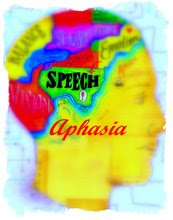
Today I will explain the function of specific areas in the brain for language functions. The brain has two hemispheres, the right and the left, and Corpus Collosum, that connects the two hemispheres. The right hemisphere is about non-verbal sounds (among other things) and the left hemisphere is about language.

Wednesday, August 29, 2007
Sen. Tim Johnson second chance at life and work

Sen. Tim Johnson's Second Chance at Life and Work
Bob Woodruff Follows the Remarkable Recovery and Return of the South Dakota Senator
Senator Tim Johnson, who returned to South Dakota today for the first time since suffering a brain hemorrhage last December, says he plans to run for re-election in 2008. "I expect to run and to win," he said. (Office of Senator Tim Johnson)
From Nightline
By DAN MORRIS and JAIME HENNESSEYAug. 28, 2007
Sen. Tim Johnson, D-S.D., addressed a crowd today in Sioux Falls, S.D., "Wow. You guys are a sight for sore eyes. It's good to be home."
It's been a long road home for the senator in the eight months since the brain hemorrhage that nearly killed him in December. In that time he's had to learn to walk again and to cope with speech slowed by aphasia.
Related Stories
"I am back and I promise you all that I will work harder than ever for you and for our state," Johnson said.
One thing Johnson, who will return to the Senate on Sept. 5, hasn't lost is his sense of humor.
"I will promise you that when my speech is back to normal, I will not act like a typical politician and overuse the gift."
"Of course, I believe I have an unfair edge over most of my colleagues right now — my mind works faster than my mouth does," he said. "I'm hoping that folks will focus more on my work than how quickly I walk these days."
Johnson has always been a straightforward, moderate Democrat from a mostly Republican state. He is a man so respected by his colleagues that they made him chairman of the Senate Ethics Committee. He is also the only senator with a son who has served in Afghanistan and Iraq.
When Johnson fell ill with what appeared to be a stroke, the outpouring of concern from both sides of the aisle was heartfelt and genuine.
White House Press Secretary Tony Snow told reporters, "This is a time to pray for Tim Johnson's health, and I'll leave it to others to start doing political calculations."
Dec. 13, 2006
Shortly before noon on Dec. 13, 2006, Johnson was conducting a telephone news conference when his words began to falter.
"I looked at him and kind of gave him a sign like wrap it up. And he said, 'Frustrating.' He said frustrating, I think two times," Johnson's communications director Julianne Fisher said. "And I turned and looked at his scheduler and pulled her aside and said, 'I think he's having a stroke.' … By 12:15 he was probably in the ambulance and gone."
Johnson only recalls part of that day.
"I remember that time, and all the way to the emergency room— ambulance ride, the emergency room. And then I become vaguer. I don't remember anymore," he said.
Johnson was unaware that the scene outside George Washington Hospital quickly became a media circus, much to the dismay of his worried family and staff inside.
Monday, August 27, 2007
Joseph Chaikin
Joseph Chaikin (September 16, 1935–June 22, 2003) was an American theatre director, teacher and playwright. He suffered from heart complications as a child, and was sent to a children's hospital in Florida the age of five. It was during this period of isolation that he began to experiment in the theatre.
He briefly attended Drake University in Iowa, and then went on to work with The Living Theatre before founding The Open Theater an experimental theatre co-operative that progressed from being a closed laboratory to performing devised work to an audience. In 1970 they performed Endgame by Samuel Beckett, with Chaikin playing the role of Hamm, at the Grasslands Penitentiary, a fulfillment of his desire to experiment with audiences who would be fundamentally different to the ones they were playing for. In 1970- 71 they performed Terminal by Susan Yankovitz in many maximum and minimum security prisons on the East Coast of the USA and Canada. The Open Theater ran for about ten years. Chaikin wound the company up to avoid its institutionalising, since it achieved critical success, something which he spurned saying, "I have rarely known a case where a critic's response to actors, directors or writers has expanded or encouraged their talent- I have known cases where by panning or praising, the critic has crushed or discouraged creative inspiration".
He then formed a company called The Winter Project, whose members included Ronnie Gilbert and Will Patton. Chaikin had a close working relationship with Sam Shepard and together they wrote the plays Tongues and Savage/Love, both of which premiered at San Francisco's Magic Theatre. They were commissioned to write When The World Was Green for the 1996 Olympics in Atlanta, Georgia. Beyond performing in his plays, Chaikin was an expert on Samuel Beckett, directing a number of his plays including Endgame at the Manhattan Theatre Club. Beckett wrote a poem for Chaikin entitled What Is the Word?. He received six Obie Awards, including one for Lifetime Achievement, and two Guggenheim Fellowships.
In 1984, a stroke suffered during open-heart surgery left Chaikin with partial aphasia. Despite this barrier to communication, Chaikin continued to direct and to create plays collaboratively with other writers, including John Belluso, whose disability-themed plays were produced at the Mark Taper Forum, Trinity Rep, Pacific Repertory Theatre and the New York Shakespeare Festival. Chaikin was also a lifelong teacher of acting and directing, and lived in New York's West Village until his death.
In 1972 his book, "The Presence of The Actor" was first published with a second edition in 1991 published by Theatre Communications Group. It includes exemplar notes, photographs and exercises from several Open Theatre productions as well as presenting Chaikin's philosophy on how theatre can bring about social transformation.
Chaikin was born and died in New York City. His son, Mauricio, now resides in Deer Park, New York.
Tuesday, August 21, 2007
Language Evolution’s Slippery Tropes

This view now faces many rivals. The big-bang theory has been countered by linguists who believe that just as the eye evolved to meet a need for vision, language evolved to meet the need for communication. Ms. Kenneally ushers onto the stage researchers who have discovered that many animal species possess languagelike skills previously unimagined and, without benefit of syntax or words, have a complicated inner life. They believe that the study of animal language and gestures could shed light on a possible protolanguage stage in human development.
Dr. Ronald Cohn/Gorilla Foundation/PBS
Koko, a gorilla with a vocabulary.

A Novelist in Shadowland
To have this happen to me is a great fear of mine. I greatly sympathize with West's condition, and I found the first part of this article (the italicized part written by his wife) fascinating and unnerving, brief though it was.
However, when I got to the excerpt of West's memoir, I almost immediately lost interest. I can appreciate flowery prose, but it seemed to me as though his writing was intentionally overwrought; as though he could banish the aphasia by making his statements more complicated and treacly than necessary. I would have liked to read his story told in a simpler light, but perhaps he thought that would have been a surrender to the effects of the stroke.
Thanks for posting this.
posted by Shecky at 4:20 PM on August 17
However, when I got to the excerpt of West's memoir, I almost immediately lost interest. I can appreciate flowery prose, but it seemed to me as though his writing was intentionally overwrought; as though he could banish the aphasia by making his statements more complicated and treacly than necessary. I would have liked to read his story told in a simpler light, but perhaps he thought that would have been a surrender to the effects of the stroke.
Thanks for posting this.
posted by Shecky at 4:20 PM on August 17
I knew that the left hemisphere processes positive feelings, the right negative ones; unopposed, the remaining right hemisphere could spark dark angry emotions for the rest of his life.
Next.................
Subscribe to:
Posts (Atom)



She had been an english teacher.
posted by miss lynnster at 4:18 PM on August 17 [3 favorites]